

Man vs. Machine
Or is it . . Man PLUS Machine?

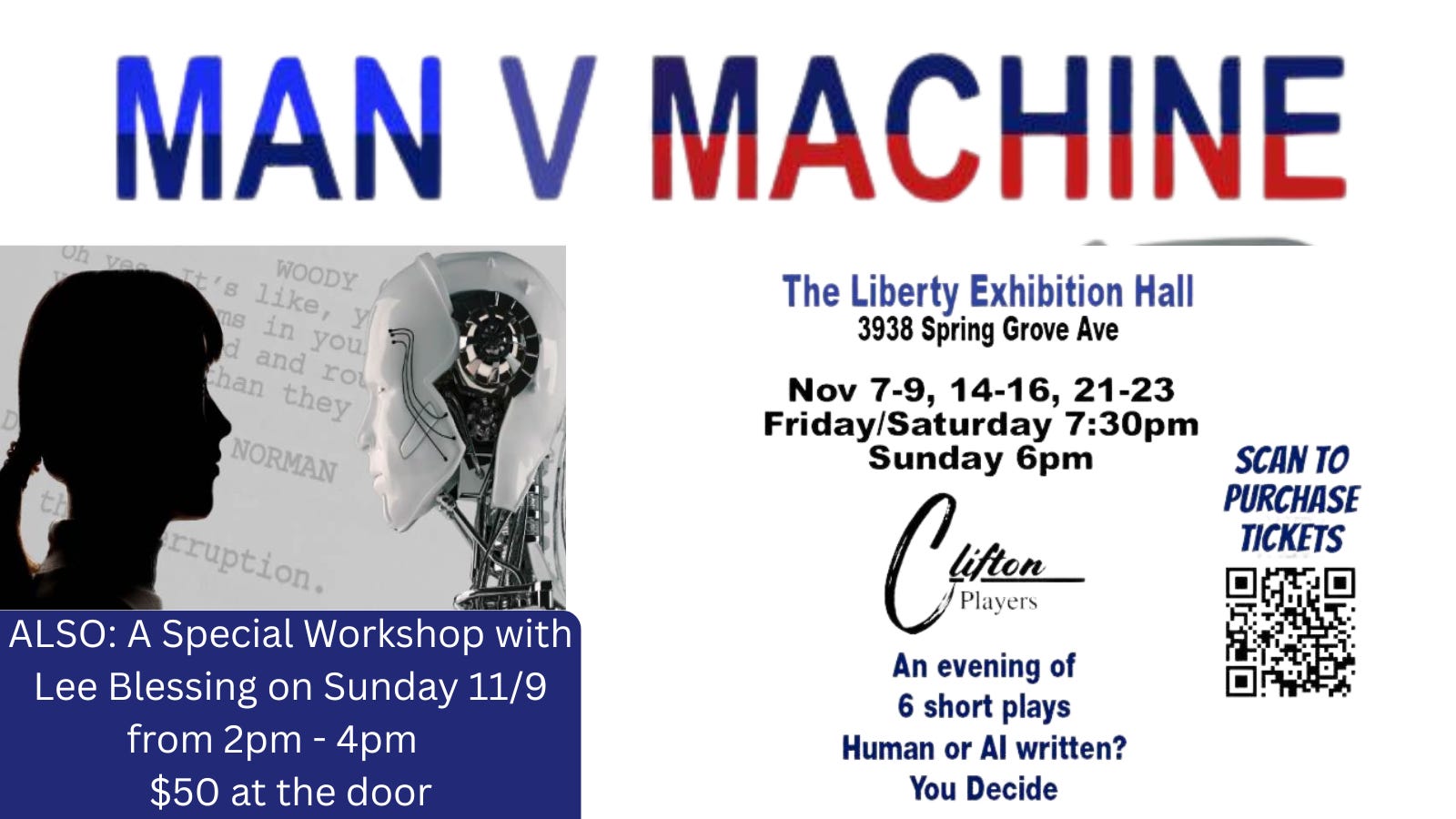
I walked into Liberty Exhibition Hall ready to play detective. Six short plays about love, some written by humans, some by AI, and nobody - not even the actors or directors - knows which is which. My job as audience member: figure it out.
But I had a more specific game going. I know these human playwrights. I’ve seen several of Kevin Crowley’s plays (”Sarge” remains the singularly most emotionally-wrecking play I’ve ever seen.) I was fortunate enough to spend three weeks learning from Zina Camblin in a writing workshop and aspire to be as good as she is. Lee Blessing is one of America’s most well-known playwrights. So I’m not just trying to spot the robot - I’m trying to identify individual voices, match plays to writers I’ve seen work before.
The evening moved fast. Six ten-minute plays in just over an hour, using both stage and floor spaces so there’s no downtime. The Massage, To Begin--The End, King of the World, Bad People, The Ghost of the DMV, The Importance of Being Eric. I watched, I listened, I tried to decode.
Some of the performances were worth noting. Tracy Connor was fantastic in To Begin--The End - I’m glad I didn’t have to wait for my annual viewing of Home Alone to see her act again. (Yes, she’s the cashier who asks Kevin where his parents are in the classic holiday film.)
Olaf Eide was strong in that piece too, and showed real versatility playing a vastly different character in The Ghost of the DMV. Eli Davis was great in The Importance of Being Eric. The whole production moved smoothly - credit to Kevin Crowley and a big assist from stage manager Annette Ouchie.
Here’s what made my mission complicated: a play is only as good as its script AND its actors AND its direction. Great writing gets diminished by weak performances. Mediocre scripts get elevated by brilliant actors. Theatre is multiplication - every creative choice either amplifies or undermines the others. So when something lands or doesn’t land, what am I actually evaluating? The writing, or everything else?
For example, I thought Bad People, with Denise Dalvera and Ryan Bowron under Paul Morris’s direction, was the best of the bunch – the writing, the staging, the acting were all top notch.
After all six plays were completed, the room went quiet. I think people expected a reveal - this one was AI, this one was human - but it never came. Instead, we got a question: “Which ones do you think were AI and why?”
No one raised their hand.
Perhaps the better question - and one I think the evening raised - is “Can AI replicate the depth of human emotion, especially around the theme of love?”
I know the answer is yes, but not because I’m a playwright. Because I’m a therapist.
I have clients who use AI in ways that genuinely help them. One asked ChatGPT to analyze a text conversation with her mother - is this toxic, or are my boundaries reasonable? The responses were objective yet validating, gave her perspective she needed. Another journals with AI regularly, getting feedback that makes them feel less alone. These aren’t gimmicks. These are real people having real breakthroughs, real emotional experiences with a computer.
So yes, AI can make people feel something. But as a playwright, I’m asking something different: Can it capture voice? Can it sound like me?
When I use AI as a writing collaborator, it helps me validate ideas, process themes, find throughlines, clean up grammar. We all embraced Spellcheck without drama. Then Grammarly. We accepted these tools because they made our work sharper. So why the visceral resistance to more advanced language models doing more advanced work?
I dare you to read one of my plays and tell me it doesn’t sound like I wrote it. Because I did. AI often helps in various ways, but it’s still mine.
I never bylined “By Kirk Sheppard and Grammarly” after all.
But in writing forums? The judgment is real and intense. Writers who use AI are treated like cheaters or frauds - not real writers. I’ve felt it. It’s isolating.
I’m not naive about this. There are legitimate questions about AI in education - how do we ensure students are actually learning to write, not just learning to prompt? And AI psychosis is a real phenomenon - we need caution and boundaries.
Coincidentally, while driving home from the theatre, I turned on a Disney World podcast that I regularly listen to. This week, the two travel agents who host it asked ChatGPT and Google Gemini to plan vacations, then spent the episode laughing at how badly the AIs did.
But I was laughing at them. Their prompts were terrible - vague, open-ended, unclear. Garbage in, garbage out. Programming 101.
Artificial intelligence is only as intelligent as the person using it.
That’s what tonight was really about. Not whether machines can write plays about love, but whether we’re asking the right questions. Whether we understand what these tools can and can’t do. Whether we’re thoughtful enough to use them well.
And not to get too meta, but I’m writing this with Claude, an AI. I told it what I experienced, what I’m thinking, where I want to go. It helped me see structure, asked clarifying questions, pushed me to articulate what I actually mean. It’s doing what good collaborators do - making the work sharper, clearer, more itself. But these are my thoughts, my experiences, my voice. Just like those plays tonight - whether written by Lee Blessing or a language model - they needed human actors, human directors, human audiences to become theatre. Creation is always collaborative. We’ve just expanded who (or what) gets to be in the room.
Maybe the most interesting work happens in the grey space - not human OR machine, but human AND machine. Not replacement, but collaboration. Not laziness, but leverage.
The question isn’t whether AI can replicate human emotion. It’s whether we’re brave enough to explore what happens when we work together, honestly and thoughtfully, to create something neither of us could make alone.
I still don’t know which plays were written by humans and which by machines. They’ve promised to email that information later. And while I’m curious, I’m more interested in watching how creatives adopt these tools - or resist them - in the months and years ahead. What questions we ask. What boundaries we set. What we create together.
For me… well... I’ve seen Terminator 2. And I’ve decided to be friends with the robots.
MAN VS. MACHINE is a co-production between The Clifton Players and The Southern Theatre Company of Hot Springs, Arkansas. It runs through November 23rd at Liberty Exhibition Hall. Tickets and more information can be found here.
Also, on Sunday, November 9th, Lee Blessing will host a playwriting workshop from 2pm - 4pm. Only $50 - payment accepted at the door in form of cash, check, or Venmo.