

Heavy, Harnessed
Mothering and Mourning & Rooms of Grief: An afternoon at the Kennedy Heights Arts Center

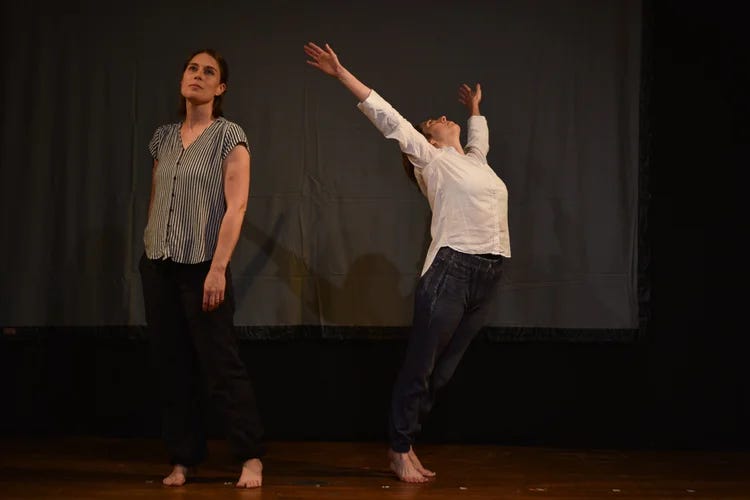
On stage, the dance troupe of five was showing all sides of what it means to be a caregiver. And behind me, a baby fussed and cried. Next to me, a boy kept drifting into my personal space until his big sister gently corralled him. Mothering was happening everywhere in that room.
It was immersive theatre, even if not by design.
Mothering & Mourning, created by Megan Flynn and Teresa VanDenend Sorge, originally premiered at the 2023 Cincinnati Fringe Festival. I missed it then, but I attended a workshop with Teresa a few weeks ago, which led to an invitation for this remounted performance at the Kennedy Heights Arts Center Lindner Annex. It was part of a larger “Rooms of Grief” exhibit, which I’ll get to later.
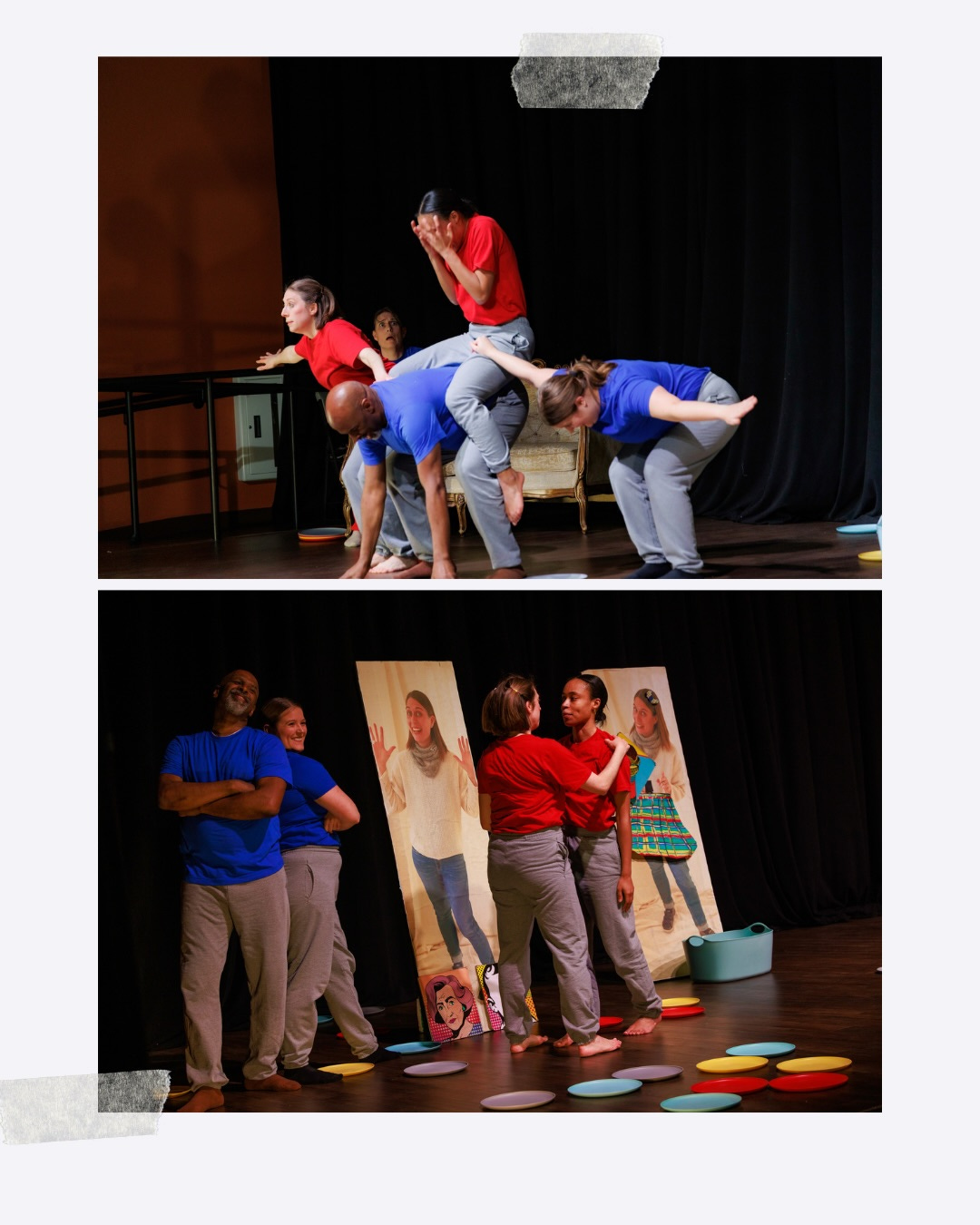
The program describes the piece as “dedicated to the absurdity of caregiving and the mother-like folks unfazed by the mess.” It’s an hour-long work composed of pieces spanning over a decade, performed by Flynn, VanDenend Sorge, and a cast that includes Rodney Veal, Nadia Ureña, and Hannah Jenkins. I am not sophisticated enough to comment on the technicalities of modern dance. What I can speak to is what it made me feel.
“Home Bodies,” set to Lionel Richie’s “Dancing on the Ceiling,” let the room breathe. Watching Megan Flynn smile and move with something close to joy after the heavier pieces was like a window opening — still serious, still grounded, but with light coming through. “Evelyn,” Flynn’s solo about a cancer diagnosis, was stunning in its simplicity: she manipulated a flashlight into her top, and her body glowed red, suddenly an illuminated thing being examined. The lighting evoked the claustrophobia of an MRI, and the movement told a story I could follow without a single word.
But it was the excerpt from Teresa’s “Motherload: a very large amount of something valuable” that undid me. Teresa embodies the sandwich generation — caring for aging parents and young children simultaneously. In the climax of this piece, she is literally drowning in Legos. I watched her move through exhaustion, trying to hold it all together while drowning in the small, sharp details of caregiving. I was terrified she’d step on one. I think that was the point.
The two lead artists are very different dancers—both free and inventive, but different energies. They complement each other beautifully. And I loved the diversity of the cast: different ages, different bodies, each person bringing something singular. Nobody was striving for perfection, just honesty.
I turn fifty this week. And what I’m realizing is that fifty comes with its own kind of mourning—not for people I’ve lost, though there’s that too, but for the versions of myself that never got to live. The things I didn’t do soon enough. The years I spent hiding instead of being seen. I’ve been writing all year on my blog, “50,” about allowing myself to dance in public for the first time, about what it means to let my body be witnessed without a script or a safety net. Sitting in that room today, watching these artists move so fearlessly in their own skin, I felt the ache of wanting the freedom they have. And also, maybe, the beginning of believing I could get there.
After the performance, I drove the short distance to the Kennedy Heights Arts Center’s main building to see Rooms of Grief, a visual art exhibit featuring work by local artists. I figured it would be sad. I didn’t expect to be so profoundly affected.
The exhibit is exactly what it sounds like: rooms full of grief, each piece an artist’s attempt to give shape to the thing that doesn’t have one. Anastasia Schneider’s “Long Shot” transforms bodycam footage of her brother’s shooting into a room built from legal documents. Melvin Grier’s “Unfinished Lives” photographs streetwise memorials for gun violence victims on Reading Road in Avondale — an image from 2005 that still speaks twenty years later. Mia Natas’s polymer clay crow plays a requiem on a willow guitar whether anyone listens or not. River Kirby’s “Forget Me Not” is a reliquary for local wildlife killed on our daily commutes, and visitors are invited to open its doors and join in a quiet act of caring.
Zoë Peterson, an artist who was at that same workshop in Covington, created “With Sympathy,” a mixed-media piece about small-town Kentucky funerals where everyone arrives with plates of food and everyone always dies too young.
And then I stood in front of Susan Carlson’s “Heart, Harnessed for Carrying.” A sculpture made of wire, acrylic, cloth, and metal, created after Carlson’s nineteen-year-old son Ben died in a climbing accident. The metal spike speaks to the weight. The bandages speak to the attempts to soothe what can’t be soothed. I read the placard, looked at the piece, and my throat closed.
Grief takes every shape. It sits in every room. Sometimes it’s a mother drowning in Legos. Sometimes it’s a heart with a spike through it. Sometimes it’s a man turning fifty, standing very still, wondering what he might have built if he’d started sooner.
Last night I wrote about chasing euphoria at Anything Goes. Today I got its opposite. Today I sat with grief.
I still am.
That’s what art does, you know?
Mothering & Mourning was performed at the Kennedy Heights Arts Center Annex. Created by Megan Flynn and Teresa VanDenend Sorge, with performances by Flynn, VanDenend Sorge, Rodney Veal, Nadia Ureña, and Hannah Jenkins. For more about the artists, visit flynndance.org and teresavandenendsorge.com.
Rooms of Grief is on view at the Kennedy Heights Arts Center through March 14, 2026. Admission is free. More information can be found at kennedyarts.org. Co-curated by Ena Nearon (Ten Talents Network) and Mallory Feltz (KHAC). Exhibiting artists: Patricia Acker, Ebony Alli, Lisa Andrews, Cora Arney-Georgilis, Lauri Ann Aultman, Brooke Cahill, Nina Caporale, Susan Carlson, Ben Casuto, Samuel Casuto, Robert Coates, Heather Conley, Isabella Crowe, Billie Cunningham, June Pfaff Daley, Leslie Lehr Daly, Dan Dickerscheid, Deborah Dixon, Mary Anne Donovan, Judith Effa Ford, Melvin Grier, Nikita Gross, Zephyr Grove, Ell Halim, Kendall Hall, Donna Hardy, Robin Hartmann, Art Hasinski, Jessica Grady Heard, April Huerta, Lindsey Hurst, Ruth Jose, Michael Kearns, River Kirby, Deborah Kovacs-Sturdevant, Cynthia Kukla, Robyn Lince, Lindsay McCarty, Micah Mickles, Carol Mohamed, Amy Mueller, Mia Natas, Zoë Peterson, Kat Rakel-Ferguson, Su Ready, Fatemeh Rezaei, Janet Rocklin, August Roth, Anastasia Schneider, Gerrie Schon, Jamie Schorsch, Zachary Severt, Charlemae Sexton, Kimberly Wilfong Sigman, Emily Sites, Matt Steffen, Shawn P. Sweeney, Megan Taylor, and Brianna Wallace.
Kirk Sheppard writes about Cincinnati theatre—but mostly about being human. Check out kirksheppard.com for more information.
So powerful. This one feels extremely resonant.