

Atten-HUT!
"A Soldier's Play" at Cincy Shakes Demands Your Attention

I grew up hearing it constantly: black on black crime. That was the real problem, I was told. African Americans needed to stop blaming white people for their struggles because white people weren’t in the cities attacking and shooting Black people. They were doing it to themselves.
I bought into it. Partly because I grew up in a small town in rural central Ohio and didn’t actually know any people of color. Partly because I was fed a steady diet of Rush Limbaugh and the voices on 700 WLW. Dr. Dobson. Focus on the Family. Voices that, I can say now with the clarity of distance, led me astray as an impressionable young man.
I share this not as confession but as context. Because sitting in Cincinnati Shakespeare Company’s Otto M. Budig Theater watching Charles Fuller’s “A Soldier’s Play,” I felt something—a recognition of where that rhetoric came from, what it was designed to do, and how deeply it had burrowed into my understanding of the world.
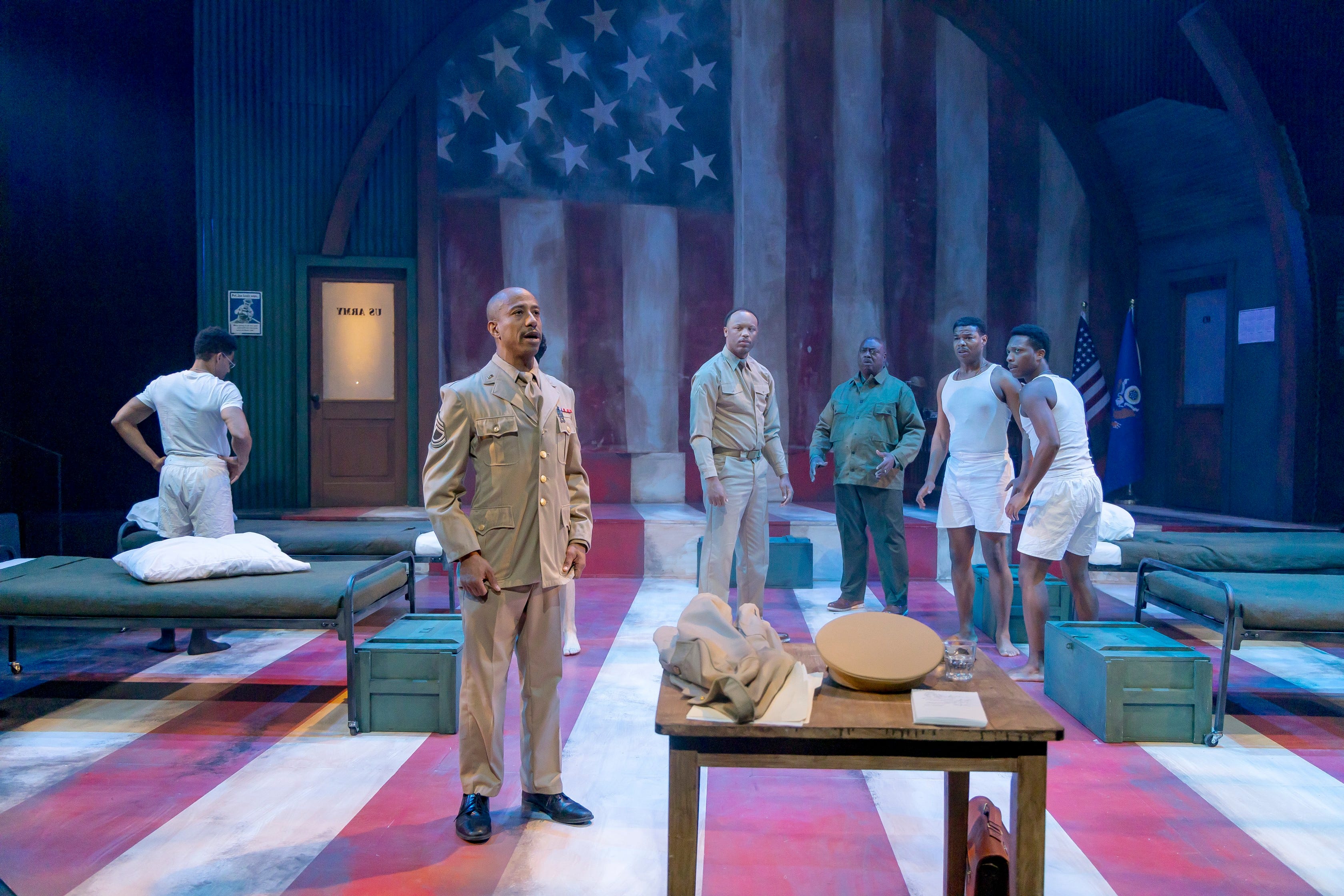
The play, set in 1944 at a segregated Army base in Louisiana, follows Captain Richard Davenport (K.P. Powell), a Black officer investigating the murder of Tech Sergeant Vernon Waters. It’s a mystery, yes, but Fuller isn’t interested in whodunit as much as what made this possible. And what made it possible is a system so corrosive that it turns a man against his own people—convincing him that their destruction is the path to his own survival.
I want to approach this with cultural humility. I am not the person who should be commenting on these issues, or perhaps even this play. But I can tell you how it landed in my body: watching the power structure of the military subverted by color, I felt angry. Sad. Helpless. Not unlike how I feel watching the news these days.
Geoffrey Warren Barnes II delivers a Waters who can turn on a dime—charming one moment, then despicable the next, his self-loathing turned outward with devastating consequences. In one scene, he berates his fellow Black soldiers for essentially being Black, for not performing whiteness well enough to earn respect from men who will never give it. It jarred me. Unsettled me. I felt fury on behalf of those soldiers while simultaneously recognizing my own privilege—the luxury of having never been asked to hate the color of my skin or my cultural identity to survive.
K. P. Powell’s Davenport is our guide through this moral labyrinth, and his direct address to the audience creates an intimacy that makes the investigation feel personal. We are implicated. We are the ones who must sit with the answers he uncovers.
The ensemble work here is remarkable. I found myself craving more moments when they were all together on stage—their collective energy is that magnetic. “ranney,” as Private Wilke, draws you in with his subtle innocence and earnest desire to do right. Montez Jenkins-Copeland brings musicality to every moment, his singing voice a balm in a story that offers few. Patrick Phillips, in a brief turn as Lt. Byrd, is memorably villainous. And Brent Vimtrup gives us something unexpected as Captain Taylor—lighter moments, yes, but also a portrait of a man almost uncomfortable with his own power, uncertain what to do with authority he didn’t earn through merit but through melanin.
Christopher V. Edwards’ direction harnesses the energy of the space and the technical elements—Jessica Drayton’s lighting and Derek G. Graham’s sound design are as polished as anything I’ve seen—to keep us engaged through a dense, layered plot while ensuring each character’s arc remains distinct. That’s no small feat with a story this complicated.
At the play’s end, Taylor comes to see Davenport and admits he was wrong. It’s not enough. It’s never enough. But in a story this heavy, I found myself grateful for even a microdose of hope. These days, I look for them wherever I can find them.
I spent years protected by a lie shouted as fact. Fuller's play strips that protection away. And I need to sit with that for a minute.
“A Soldier’s Play” runs through February 15th at Cincinnati Shakespeare Company. Get tickets now at CincyShakes.com.
Kirk Sheppard writes about Cincinnati theatre—but mostly about being human. Check out kirksheppard.com for more information.